

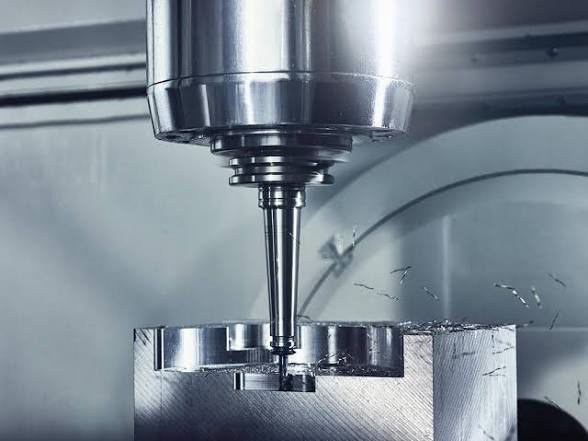
An end mill with four flutes is designed to share the cut four ways. When the tool runs out of true, the share is uneven. One flute reaches further into the material on every revolution and takes a thicker chip, and the flute opposite takes a thinner one.
The heavily loaded edge wears first. The tool is changed when that edge gives up, whatever the state of the other three. An edge that should have lasted to the planned change is pulled early, and its cost is spread across fewer good parts.
Where runout comes from
Runout measured at the cutting edge is the sum of every interface between the spindle and the tool: the spindle taper and its bearings, the holder taper and the face it seats against, the collet or sleeve that grips the shank, and the shank itself.
Most of it is avoidable. Chips or coolant residue on a taper, a collet that has opened up over hundreds of clamping cycles, a nut tightened by feel rather than to torque — each adds a few microns, and they add together.
Measured at the tip, not the shank
Runout is an angle as much as an offset. A holder a few microns out at its nose is further out at the tip of a long tool, because the error grows with stick-out. That is why runout is quoted at a stated distance from the nose, commonly two and a half to three times the tool diameter, and why it should be checked there with a dial indicator before a trial begins.
How the collet series compare
| Series | Bodies | Runout | Parts |
|---|---|---|---|
| SC high-precision | SC20–SC42 | 1.5 µm | 82 |
| ER, UP < 0.005 mm | ER16–ER32 | 5 µm | 51 |
| ER coolant, UP < 0.005 mm | ER16–ER32 | 5 µm | 43 |
| ER, UP < 0.008 mm | ER16–ER32 | 8 µm | 51 |
The figures are the maximum each series is ground to. A collet is only as good as the holder and nut it runs in, and a precision collet in a worn chuck will not reach its own number.
Before choosing a holder
- 01Clean the spindle taper and the holder taper before every measurement.
- 02Retire collets on a schedule, before parts start to drift out of tolerance.
- 03Tighten collet nuts with a torque wrench, to the maker’s figure.
- 04At high spindle speeds, check balance as well as runout.
At the machine
Carbiforce application engineers measure runout on the customer’s spindle during diagnosis, before any tool or holder is recommended. The reading goes into the trial report next to parts per edge and cost per component.